The Story of Michael Griffith

Michael Griffith was born on March 2, 1963. Michael’s family immigrated to the United States from Trinidad in 1973. Once in the United States, the family resided in the Crown Heights neighborhood in Brooklyn, New York at 1650 Pacific Street. On the night of Friday, December 20, 1986, a 23-year-old Michael Griffith drove to pick up his paycheck from his construction job. Michael Griffith was accompanied by 36-year old Timothy Grimes, 20-year-old Curtis Sylvester, and 36-year-old Cedric Sandiford in Sylvester’s 1976 Buick, when the car overheated on an isolated stretch of Cross Bay Boulevard near the Far Rockaway neighborhood. Curtis Sylvester, Griffith’s cousin and the driver, stayed in the car while the other three men went to find help. Griffith, Grimes, and Sandiford walked three miles north to Howard Beach, a historically insular, and white-majority neighborhood. 

Upon arrival at Howard Beach, the three Black men were met with instant harassment from a group of white residents that shouted anti-Black slurs and urged them to leave the neighborhood. The men made a stop at the New Park Pizzeria located on Cross Bay Boulevard and 157th Street in Howard Beach around 12:30 AM. When the men were denied phone use at the pizzeria, they decided to rest and eat pizza. Police officers from the 106th Precinct received a call about “three suspicious Black men” at the pizzeria. The officers headed to the pizzeria to respond to the call but left with no complaints from the employees. After the three men left the pizzeria around 12:40 AM, a mob of multiple white men that brandished bats, tire irons, and tree branches approached them. The mob of white men shouted several anti-Black epithets at the three men. The three men tried to run away but were eventually caught and beaten by the mob. 

After he was struck once, Timothy Grimes was able to escape the white supremacist mob’s violence and fled home. Michael Griffith and Cedric Sandiford unfortunately faced severe beating, but eventually broke from the beating and ran while the mob pursued them. The two men ran north on Cross Bay Boulevard to 158th Avenue, turned west and ran to 84th Street, where they tried to crawl through a three-foot hole in a fence lining the Shore Parkway. Griffith and Sandiford were caught by the mob and subjected to beatings for the second time. The two men were able to escape again by crawling through the hole in the fence. Griffith and Sandiford split up this time as they fled from the violent, white mob. About eight blocks away, at Cross Bay Boulevard, Mr. Griffith tried to cross the busy parkway to the westbound lanes and was struck and killed by a passing car. His body was recovered by officers that responded to a report of the beating at 12:53 AM around 84th Street but found no one at the scene. Around 1:03 AM, officers responded to another report, which led them to Griffith’s body. Sandiford was found farther west on the parkway by officers bruised and dazed. Sandiford was treated at Jamaica Hospital and released home. Ms. Jean Griffith, Michael Griffith’s mother, was notified of Michael’s death at 2 AM. Chris Griffith, Michael Griffith’s brother, was interviewed at the 106th Precinct and confirmed that he was in the area to pick up a check from his construction job. Chris Griffith also stated: ”She doesn’t know anything about prejudice. She just doesn’t understand it.”

The immediate reaction to the news of the anti-Black mob beating and death elicited responses from New York City Mayor Ed Koch, Police Commissioner Benjamin Ward, Queens Borough President Claire Shulman, Howard Beach community leaders and residents, Black residents of New York City, and Black civil rights leaders.

”All crimes are terrible, but crimes involving racial bigotry are the absolute worst,”
Mayor Koch said at an afternoon news conference at the 106th Precinct station house.
”The survivors were chased like animals through the streets, with one of them being killed on the highway.” Noting that a $10,000 reward had been posted for the capture of the assailants, the Mayor added, ”This incident can only be talked about as rivaling the kind of lynching party that took place in the Deep South – this is the No. 1 case in the city.”

New York City Mayor Ed Koch, December 21, 1986

Queens Borough President Claire Shulman gave a public statement after meeting with officers from the 106th Precinct: ”This is a very tragic incident. I am confident the Police Department will investigate the crime fully, and we all look forward to the apprehension of those who are responsible.” Police Commissioner Benjamin Ward described Howard Beach as an “ethnic enclave” of Irish, Italian, and German immigrants. The local residents of Howard Beach hired private security agencies to patrol the neighborhood. The 106th Precinct reported that there have been no major racial incidents, although they’ve admitted to fights between Black and white people in the neighborhood. Joel Mielle, the Chair of Community Board 10 for eight years at the time of Griffith’s death, stated that he knew of one incident of a Black man being stopped, but denied that racist violence was a fabric of daily life in Howard Beach: ”We haven’t had, to my knowledge, any pattern of racial incidents here for as long as I can remember.”

Black community leaders and residents spoke of an entirely different reality of Howard Beach’s anti-Black culture. Black community leaders cited the mob beating as a reflection of the deep-seated racism of Howard Beach’s community. Reverend Mitchell, a Black minister of Flushing neighborhood in Queens, stated “Howard Beach is a place where blacks don’t like to go. They know of the hostility and virulent racism there.”

The sentiment from Reverend Mitchell and other Black residents within New York City were vindicated, when several white residents of Howard Beach and surrounding neighborhoods spoke to reporters in response to the mob beating and death of Michael Griffith, although some white residents acknowledged that Black people were unwelcome to the neighborhood. Many of the angry white residents hired the Pinkerton security guards to patrol the neighborhood after their claims that Black residents are behind robberies and crime in the neighborhood. A white Howard Beach resident by the name of Jimmy stated “It’s very easy to spot a black person in this neighborhood, and whenever I see
one, I know he’s up to no good…They come in the neighborhood and rob everybody. It’s a
known fact. That’s why everybody has a thing about them.”

A few others shared this sentiment and blamed Mayor Koch for the incident: “Koch and Ward jump in and say ‘racism’. Why should they assume it’s racism just because it’s between black and white? The Mayor, better he should jump on his corrupt administration than try to destroy a good community.'” Another resident stated Black people’s alleged crimes in Howard Beach were overlooked: ”Nobody knows the real story of what goes on around here. Before we had private security, there was a lot of that kind of crime. But the Guardian Angels weren’t here for that, the police brass weren’t there for that.”

Ironically, one of the hired Pinkerton security guards that worked to patrol Howard Beach from the alleged crimes committed by Black people is a Black man by the name of “Rob.” He spoke about his experience as he patrolled the neighborhood:

He described racial epithets and said he feared leaving his vehicle to investigate trouble because ‘I don’t want to get mugged by white guys. I patrol the neighborhood for them, meaning the white people,’ and they don’t even want me here. This place is dangerous.’

Over 50 New York City police officers went to different homes in Howard Beach in hopes of names of the perpetrators. Officer James Coleman stated that the investigation was in progress and that it is believed that the suspects indeed were Howard Beach residents. The man that fatally hit Michael Griffith with his car was identified as 24-year old Dominick Blum, a court officer from Brooklyn. Blum claimed that he thought he ran over a tire or animal, but was urged to return to the scene by his father, a New York City Police officer. Police Commissioner Benjamin Ward stated that at the time, there was no evidence to connect Blum to the mob beating, but that it would still be handled at Grand Jury.

On December 21, 1986, three white teenagers were held and charged with second-degree manslaughter in the beating of Grimes, Sandiford, and deceased Griffith. After the officers canvassed different homes, it led to a to a tip-off of one of the suspects, that eventually implicated the others. The suspects were identified as John Lester, 17, of 81-17 149th Street, Ozone Park, and two Howard Beach youths: Jason Ladone, 16, of 161-23 89th Street, and Scott Kern, 17, of 87-14 158th Street. A fourth suspect was arrested, Thomas Gucciardo, 17, of 163-28 90th Street, but assault charges were dropped. The office of Queens District Attorney John J. Santucci, stated that prosecutors would seek “to prove that Mr. Griffith’s death occurred as a result of actions performed ‘with depraved indifference to human life.” The charge carries a maximum sentence of 25 years to life in prison.”

According to the police investigation, the suspects were in attendance at a birthday party, but happened to be outside when they saw Griffith and his friends headed to the pizzeria. The three main suspects went back to the party to rile up others, which resulted in about 12 people that left to go terrorize Griffith, Grimes, and Sandiford. Seven other potential suspects were questioned by the 106th Precinct, but it was unclear whether they would be charged. The three main suspects were set to be arraigned in Queens Criminal Court. In the same night of Griffith’s death, a group of white Howard Beach residents attacked two Hispanic men, 19-year old Rafael Gonzales and 15-year old Greg Torres, around 10:45 PM. Upon the arrests of the three main suspects in the beating and death, Mayor Ed Koch held a press conference:

Think what they must have felt as they were running for their lives. To have it happen in New York City- unbelievable. This is the most horrendous incident of violence in the nine years I have been Mayor. We have 1,800 murders a year in this city and they’re all bad, but this was the worst murder I believe has taken place in the modern era.

On December 26, 1986, more than 600 people attended Michael Griffith’s funeral at Our Lady of Charity Catholic Church in Brooklyn, which he was a member of. Friends, relatives, and community members, mostly Black and other people of color, paid respects to Griffith in a two-hour service. Reverend Robert C. Seay delivered a eulogy that condemned the institution of racism and promoted racial self-esteem for Black people:

We wonder why we must continually go through this. Michael is the victim of a system that perpetuates the inferiority of a certain group of people. When young teenagers commit a crime like this, it is not only blame on them, but blame on their parents, on society, on everybody. What Michael would say is honor your race, honor your color, be proud of it, stand strong in it. If you don’t, nobody else will.

Michael Griffith was buried at his resting place at Evergreen Cemetery.

A day after the funeral, 1,200 people marched through the Howard Beach neighborhood to protest the mob beating and death. The protestors were made up of many Black and white New Yorkers that expressed anger and grief, as they marched to New Park Pizzeria for a silent prayer. The protestors were taunted and followed by many young white Howard Beach residents, that shouted at the protestors to go home and yelled pejoratives. About 200 white residents of Howard Beach grouped up to disrupt the protestors along the route. The white residents of Howard Beach still refused to acknowledge the racist reputation of the neighborhood and alluded that all claims were exaggerated. The march was organized by New York’s NAACP and the Southeast Queens Catholic Clergy.

On December 30, 1986, Judge Ernest Bianchi dismissed the murder and manslaughter charges in Michael Griffith’s murder. Queens District Attorney John J. Santucci cited Cedric Sandiford and his attorney, Alton H. Maddox Jr’s refusal to cooperate with the prosecutors as the sole reason for the second-degree murder and manslaughter charges reduction to reckless endangerment. The reaction amongst the Black community in New York City reiterated the lack of faith in the criminal justice system in hate crime cases that involve Black victims, with the dismissal of the charges viewed as “typical” and “predictable.” Black activists and leaders that led protests that supported the victims called for a special prosecutor to cover the case.

Manhattan Borough President David Dinkins stated that “lowering the charges creates the impression that New York City will tolerate the vicious actions of a racist gang.” Dinkins went on to state that Judge Bianchi’s dismissal and reduction of the murder charges was an “appalling act of disregard” for Michael Griffith’s family. Reverend Herbert Daughtry of the African Peoples Christian Organization stated that he believed many Black people did not agree with the DA’s assertion that Alton H. Maddox Jr and Sandiford’s refusal to cooperate weakened the case. Daughtry and other Black leaders agreed with Maddox Jr’s sentiment that past experiences with similar cases have shown that the allegations of a cover-up within the investigation was grounded in reality. Black leaders also agreed that Maddox Jr’s allegations of a cover-up against the prosecutor, NYPD, and Dominick Blum forced investigators to be more open with the investigation. Despite the pressure placed on those that handled the investigation, Black activists stated that many inconsistencies still existed, which left them with more questions. Black leaders planned to meet with Black elected officials to pressure Governor Mario Cuomo into the assignment a special prosecutor. C. Vernon Mason, attorney for Timothy Grimes, supported Maddox Jr’s pursuit for transparency and bid for an assignment of a special prosecutor.

‘There are still too many inconsistencies, but what is clear to me is that if a mob of blacks had killed a white person, we would have seen a different procedure here.

Rev. Calvin O. Butts, the executive pastor of the Abyssinian Baptist Church

On January 2, 1987, Mayor Ed Koch and Governor Mario Cuomo doubled down on their position about Cedric Sandiford’s lack of cooperation with the prosecutor and investigators. Maddox Jr’s criticism of the police’s handling of Dominick Blum upset Koch and Cuomo. Maddox also stated that Sandiford’s account of the death was in contrast to the police’s account. At a press conference, Governor Cuomo’s press secretary, Martin Steadman, expressed his discontent with Maddox Jr:

I think this man has no credibility, zero credibility. And I answer his reckless charges only
with sorrow because they don’t deserve to be answered. But because of the dimension of the tragedy in Howard Beach, I’m answering them.

Maddox Jr and Mason responded to reports about Santucci possibly turning the case over to federal authorities. Mason responded to the report in a phone interview: “Turning the case over to the Federal authorities is an admission that the State of New York is not prepared to confront one of the most serious racial incidents in the history of this country.” Maddox Jr shared similar sentiment: “It would tell us that we are in the same precarious position as our brothers in the South were in in the 1950’s and 60’s: that is, that the only government that would be willing to protect our civil rights was the Federal Government.” Steadman expressed for Maddox Jr and Mason to bring their grievances of police misconduct to special prosecutor, Charles J. Hynes. Maddox stated that it was not his intention to go to Hynes: “When Mr. Hynes was appointed, the scope of his jurisdiction did not envision racially biased cases, and he does not have the resources or the equipment to deal with those kinds of cases.”

On January 6, 1987, a coalition of Black leaders met at Bedford Stuyvesant’s Boys and Girls High School to plan a citywide-boycott of non-Black-owned business. The boycott was to be modeled after the Montgomery, Alabama bus boycott led by Dr. Martin Luther King Jr, with its date set for January 21, 1987. More than 1,300 people were in attendance of the community meeting, which included Alton Maddox Jr, C. Vernon Mason, Griffith’s brother, Christopher, and Griffith’s mother, Jean. Reporters were barred entrance into the meeting that excited community members into an eruption of “Black Power” chants. Brooklyn Assemblyman Roger Green spoke about the importance of the boycott: “A general boycott would place emphasis on the fact that the loss of Michael Griffith’s life will not go without protest. On January 21st, we are calling on all Afro-Americans to patronize only businesses owned by Afro-Americans.” Over 10 Black leaders expressed angry at the handling at Mayor Koch and Governor Cuomo’s involvement in the case.

A suspect alleged to have participated in the Howard Beach mob was imprisoned in an unrelated case on January 8, 1987. John Lester pleaded guilty to an illegal possession of a handgun charge in November 1986. The conditions given to Lester was that if he avoided an arrest or charge before his sentencing, he would be given five years of probation. Lester was sentenced to one to three years in prison due to his rearrest. The presiding judge granted Lester “protective custody” while in prison, but did not permit for Lester to withdraw his guilty plea in the Howard Beach mob case.

Governor Cuomo finally appointed a special prosecutor to take over the case on January 13, 1987. Special Prosecutor Charles J. Hynes’ assignment was the resolution to move the case forward, after victims refused to cooperate with the Queens District Attorney’s office. C. Vernon Mason and Alton Maddox Jr expressed through a spokesperson that they intended to cooperate fully with Hynes for the investigation. Governor Cuomo commented on his assignment of Hynes to the case: “A refusal of witnesses to cooperate because they feel, rightly or wrongly, that the investigation was being conducted improperly has put the prosecution in this case at an impasse. My concern was to first find a way to assist in the
prosecution.” Queens District Attorney Anthony Santucci accepted the decision and criticized the lawyers for “holding the victims hostage.” Hynes intended to investigate any allegations of misconduct from the District Attorney and police department’s time in the case. Hynes assigned staff workers to the case and planned to gather evidence to present to the Queens Grand Jury: “The first step, obviously, is to talk to Mr. Sandiford – he is the principal witness. The opportunity we’ve all missed is to sit down and interview Mr. Sandiford and Mr. Grimes.” Special Prosecutor Charles J. Hynes presented the evidence to the Queens Grand Jury on January 20, 1987. Hynes’ office stated that no information about the possible testimonies of Sandiford and Grimes would be released until the Grand Jury reached a decision on the indictment of the three alleged suspects.

The Day of Mourning and Outrage took place the following day in Brooklyn. Black protestors and allies in Brooklyn linked arms together in a powerful moment of silence for Michael Griffith. Protestors handed out over 25,000 leaflets to empower Black people to build political and economic power. The coalition of Black religious and political leaders urged Black people to boycott school, work, and white-owned Businesses in a response to Griffith’s death, as well as the beating of Sandiford and Grimes:

People are ready to deal with the issues that affect them. They are tired
of the black community being silent. They know that by not
being involved they can’t deal with the problems facing the
community.

Peter Williams, young Brooklyn outreach coordinator

On February 10, 1987, twelve suspects were arraigned in the State Supreme Court in Kew Gardens, after they were named in an unsealed indictment. Special Prosecutor Hynes revealed in court that one of the three youths charged with second-degree murder, 17-year-old Robert D. Riley, cooperated with his office, which led to his release without bail. Hynes requested high bail for all of the other defendants and it was granted by Justice Alfred D. Lerner. Each of the twelve defendants were brought in individually before the court room and plead “not guilty.” Others charged with second-degree murder, in addition to Mr. Riley, were 17-year old Jon L. Lester and 18-year-old, Scott Kern. In addition to the second-degree murder charges, Riley, Kern and Lester were also charged with with second-degree manslaughter and assault. The other defendants included Jason Ladone, Michael Pirone, Thomas Farino, James Povinelli, John Saggese, Salvatore DeSimone, William Bollander, and Harry Buonocore.

A part of the indictment seemed to settle a discrepancy of the published account of where Griffith entered the highway before his final moments. The early account had Griffith climb through a hole in a fence at 86th Street to enter the highway. According to a new version, Griffith and Sandiford split up quickly as they were chased by defendants. Griffith climbed over a two-foot high guard rail at 90th Street. The indictment supported the 90th Street account as Riley, Kern, and Lester ”chased Michael Griffith westward on 156th Avenue, northward on 90th Street, and caused him to run onto the Belt Parkway.” The 90th Street account puts the chase to Griffith’s death at a shorter distance, which carried legal significance that the shorter the distance he covered between his pursuers and the car that hit him, the stronger the basis for a murder charge. Supreme Court Judge Thomas Demakos was assigned to preside over the case on February 11, 1987.

At pre-trial hearings on March 7, 1987, Special Prosecutor Hynes indicated that Robert D. Riley may be able to have his murder charge lessened in exchange for a guilty-plea and testimony. Since Riley’s release due to cooperation with Hynes’ office, he was released with police protection at his home in Howard Beach. Lawyers for defendants Kern and Lester stated that they would make it an issue that cocaine was found in Griffith’s autopsy. Kern’s lawyer, Bryan Levinson, argued that while it was not a large amount of cocaine, it could’ve impaired Griffith’s judgement to cross the highway. Lester’s lawyer, Gabriel Leone, made a bold argument: “We’re saying he was never chased to begin with. But even if he had been, if the victim could have done something else but didn’t because he was drunk or intoxicated by drugs – if there were alternatives he didn’t recognize – you can’t attribute his death to the defendants.” Bryan Levinson stated that he also would raise the cocaine found in Griffith’s autopsy in connection to the start of the encounter between Griffith, Grimes, and Sandiford and the all-white defendants: “Perhaps these weren’t three innocent people walking along who were just stranded motorists, but there may have been some instigation on the part of these three people to cause the confrontation.” Toxicology experts commented that the likelihood of the low amounts of cocaine in Griffith’s system was possible, but it was not definitive:

You can damn near argue either way, depending on what your bias is. ‘You can argue this had little effect, or had significant effect on his behavior. While it was possible that the cocaine had affected Mr. Griffith’s judgment, it is difficult to tell whether, had he not had cocaine, he would have made a different decision.

Dr. S. Joseph Mule, director of the testing and research laboratory of the New
York State Division of Substance Abuse Services

Dr. Rosecan, director of the cocaine abuse treatment program at Columbia-Presbyterian Hospital, stated ”the case could be made stronger if Mr. Griffith had a toxic level of cocaine. Then it would have been more probable that he had been impaired, but it still would not have been definitive.”

On March 17, 1987, Cedric Sandiford and his attorney, Alton J. Maddox, filed a notice that would allow him to sue New York City for 25 million dollars. Sandiford’s lawsuit asserts the police conducted a bad faith investigation and failed to protect him. A special grand jury cleared Dominic Blum of all criminal charges in connection to the death of Michael Griffith on May 22, 1987. As driver of the car that fatally hit Michael Griffith, he faced a maximum sentence of up to four years in prison. The grand jury deliberated on whether Blum left the scene of the accident knowing Griffith was injured. Hynes reported that “the grand jury heard all of the evidence that was legally sufficient and made a determination.” Sandiford’s attorney, Maddox, questioned why his client was not called to testify against Blum.

The appointed judge, Justice Thomas A. Demakos, divided the case into two separate trials by request of special prosecutor, Charles J. Hynes on June 19, 1987. Hynes stated that it would make more sense to try the defendants associated with the most serious aspect of the case together. Various lawyers for the defendants also asked for the separation of the cases to avoid discrimination for their clients charged with lesser crimes, such as inciting to riot. Justice Demakos set the murder and manslaughter charge trial for defendants Kern, Lester, Ladone, and Pirone for September 8, 1987. The defendants in the second trial, charged with crimes ranging from attempted murder to inciting to riot include Gucciardo, Bollander, Farino, Buonocore, Povinelli, DeSimone, and Saggese would have to wait for the trial date to be set.

Special prosecutor Hynes revealed that victim Timothy Grimes admitted that he flashed a knife while he, Sandiford, and Griffith were followed and menaced by the defendants with a baseball bat. This revelation was made on August 18, 1987. Hynes stated that it would not have a significant impact on the case as Grimes brandished it in a “defensive way.” Defense lawyers stated that it was significant and proved that the three Black men were the initial aggressors. Grimes’ lawyer, C. Vernon Mason, stated that he did not believe the new information “has any significance at all – the initial aggressors and the continuing aggressors, legally, was that mob.” Ronald Rubenstein, attorney for Ladone, filed a motion for a dismissal of the indictment in light of Timothy Grimes admitting that he had a knife during the night at Howard Beach. The motion argued that Grimes’ failure to admit he had a knife during the encounter in his grand jury testimony was perjury and rendered the grand jury proceedings as defective. Judge Justice Demakos rejected the defense motion on August 27, 1987: “There was other sufficient evidence existing before the grand jury to support the indictment.”

On September 8, 1987, the first trial of the Howard Beach assault case officially began with Judge Demakos’ juror selection process. No jurors were selected on the first day as the extensive national attention to the case made selection difficult. Special Prosecutor Hynes retained the help of Jay Schulman, a sociologist previously involved in the anti-war movement. Schulman was dismissed from his Cornell University teaching position as a result of his involvement in the anti-war protests, but went on to support the Black and brown students activists at CUNY’s City College in their fight against racist admission changes. Schulman’s experience and commitment to social justice led him to offer advisement for juror selection to Hynes free-of-charge since his appointment to the Howard Beach case. The first six jurors were selected on September 14, 1987, with none of them being Black. The few prospective Black jurors were eliminated by the defense team. Prospective jurors stated they were eliminated as defense exercised peremptory challenges.

Prosecution and the defense lawyers accused each other of “seeking to stack the jury on a racial bias.” Special prosecutor Hynes stated the defense team abused peremptory challenges to exclude prospective Black jurors and urged Judge Demakos to apply to the defense a 1986 United States Supreme Court decision that prohibits prosecutors from doing this. The defense team accused prosecution of racial discrimination against white homeowners with the peremptory challenges. On September 21, 1987, Judge Demakos eventually ruled that the defense team used their peremptory challenges to exclude Black jurors and stated he would curb the lawyers’ use of the challenge on prospective Black jurors. Judge Demakos stated the defense lawyers would have to give non-racial explanations whenever there were ”any further allegations that they are exercising peremptory challenges against black jurors on the ground of group bias alone.” The first Black juror was selected on September 28, 1987. By October 1, 1987, all twelve jurors were selected for the Howard Beach case to begin. The jury was composed of six non-Hispanic whites, one Black woman, two people of Puerto Rican background, two Asian-Americans and a Guyanese man of Indian descent.

A few days after the jury selection was completed, lawyers received copies of the grand jury testimonies, which included defendant Robert Riley’s admission that he’d taken a baseball bat from defendant Scott Kern to attack the three Black victims. In his admission. Riley stated that he wanted the bat, but the bat was eventually taken by defendant Jon Lester. Riley’s admission was given in exchange for the dismissal of his murder charge.

Timothy Grimes testified about the night of the Howard Beach assault in front of jury on October 15, 1987. His account detailed that ten white men confronted himself, Michael Griffith, and Cedric Sandiford with a baseball bat and other weapons. Grimes stated that he pulled out a knife, after one of the white attackers hit the ground with the bat several times outside of New Park Pizza and announced “Get the nigger!” Grimes revealed that the attackers froze when they witnessed the knife, and he used that moment to run from the scene while a stick was thrown at his back. He testified that he did not see where Griffith and Sandiford ran to, but it was the last time he was Griffith alive. He saw Sandiford the following morning at the precinct with “black eyes, puffed face, stitches in his head, bruised up bad.” Grimes was cross-examined about his criminal history, reasons for being in Howard Beach, and drug use. Grimes admitted to prior criminal history, stated that Curtis Sylvester’s car was not able to make it to a gas station, and admitted to personal drug use, but stated that none of the victims used drugs prior to the assault.

A bank security guard, Alex Rios, testified that he witnessed the white mob chase one of the victims “like a posse” through the window of the closed Citibank branch, as he was there for an early morning shift. Rios saw the mob return back to New Park Pizzeria and overhead them say “we couldn’t catch him.”

On October 22, 1987, attacker turned prosecutor’s key witness, Robert Riley, took the stand to testify about the night of the encounter and death of Michael Griffith. While cross-examined by defense lawyers, Riley testified that attackers pursuing Griffith did not chase him to the edge of the traffic lanes of the Belt Parkway. Riley stated that the attackers chased Griffith up to 60 feet away from the traffic lanes, which was the start of a grass-like turf area that runs alongside the Belt Parkway. Riley testified about Griffith’s death while prosecutors asked him to describe the and sights of his final moments.

He ran across the first side and jumped over the middle. He put his hands on it and pulled himself over, then got hit by a car. I saw his body go up a couple of feet in the air, above the car. It was like a thud, a thump.

Special Prosecutor Charles J. Hynes stated that Griffith had no choice but to cross the Belt Parkway to escape from the white mob.

Riley’s testimony went on to state that the encounter began when John Lester left with others and returned to a birthday party in Howard Beach that all of the accused attackers were in attendance for. Upon his return, Lester told the attendees “there are some niggers on the boulevard – let’s go up there and kill them!” Riley stated that after an estimate of 10 beers, he and a dozen of other attendees at the party drove in three cars to confront the Black men at the intersection. Once at the scene, the attackers began to confront the Black men. He said that John Kern was hitting a bat on the floor, which led to two of the Black men to display knives, while the attackers yelled “Niggers, get the fuck out of the neighborhood!” Riley stated that victims took off running while the mob chased them on foot and by car as they yelled, “niggers, get the fuck out of the neighborhood.” Griffith was chased by Riley, Lester, Ladone, and Pirone on foot, when he eventually turned up 90th Street, then crossed the Belt Parkway to his death.

Another witness took the stand for the Howard Beach trial on October 28, 1987. The witness was a police officer that testified an imitation gun found at the scene of Michael Griffith’s death looked so real, it was sent for ballistics examination. Prosecution noted the lack of evidence to connect the imitation gun to Griffith or any other mob attack victims.

On November 2, 1987, Dominic Blum, the driver of the car that fatally hit Michael Griffith, took the stand in the Howard Beach trial. Over 300 Black New Yorkers came to support Griffith’s family and witness the testimony. Blum, a New York City court officer, maintained he was unaware that his car hit Griffith as he fled from the defendants on the Belt Parkway. He stated he only became aware that his car hit Griffith when he returned to the scene with his father and brother two hours later. Blum was not charged with the murder of Griffith. The defense attorneys sought to frame Blum as a hit-and-run driver primarily responsible for Griffith’s death. During the testimony, Blum revealed he and his girlfriend were returning to their home in Brooklyn when the accident occurred. His girlfriend, Ms. Channon, was asleep in the front seat.

”I was driving in the extreme left-hand lane and the car in front of me started slowing down,” Mr. Blum said under questioning by a prosecutor, Edward Boyar. He said that ”rather than hit the brakes,” he turned his head to his right to see whether he had clearance to get into the middle lane and then ”I heard a big bang.” He tried to get to the right shoulder and stop, he said, but it was 100 yards or so before he could do this. He said he told Ms. Channon, who had awakened, that he did not know what had happened but that he thought that ”someone threw something at the car.”

Blum stated that he put his head out the window to look back and saw traffic flowing normally. After he reached home, he spoke to his father about what happened, which eventually led to his return to the scene. While cross-examined by defense, Blum stated that he did not tell his father that he struck a person, as he claimed defense misquoted his signed police report.

Days after Dominic Blum’s testimony, defense lawyers harped on drug use as a sole reason for Griffith’s decision to run onto the Belt Parkway, rather than to escape the violent mob. On November 13, 1987, prosecution called Dr. Kenneth Tariff to dispute the defense contention that cocaine influenced Griffith’s decision. An associate professor of psychiatry and of public health at Cornell University Medical College, Dr. Tariff based his conclusions on toxicological reports from the New York City Medical Examiner’s Office, which included analyses from specimens of Griffith’s organs and fluids. Dr. Tariff stated he could not conclude how much was ingested, but the amount of time the effects may have lasted. He estimated Griffith used up to 18 hours before his death: “My opinion is that he was not under the influence of cocaine at the time of his death.” According to Dr. Tariff’s expertise, the effects would have lasted for only 6 hours with continued metabolization taken into account.

On November 16, 1987, one of the most important witnesses, Cedric Sandiford, testified about the beating he endured at the hands of the white mob in Howard Beach. On the stand, Sandiford recalled the night of the beating and Griffith’s death with vivid descriptions. Sandiford stated he was brazenly beaten with bats and tree limbs: “They were beating me all over my body, my back, my legs, my stomach, everywhere.” Sandiford stated he begged one of the young assailants for his life: “Please! Oh, God, don’t kill me! I have a son as old as you.” Cedric stated that soon after as he begged for his life, the youth “lashed me in my head and busted my head open and blood is running down the back of my neck.” Special Prosecutor Hynes asked Sandiford if he saw the assailant in the courtroom during his testimony. Sandiford stepped down and stared Jon Lester in his eyes. Sandiford returned to the stand and identified Jon Lester as the youth that attacked him with the bat. Hynes continued to question Sandiford about the following moments of the attack. Sandiford heard the mob yell “Niggers, get the fuck out of the neighborhood,” then was hit yet again with a bat. Sandiford clarified that neither himself, Michael Griffith, or Timothy Grimes carried weapons on them the night of the mob beating.

Sandiford stated that himself, Grimes, and Griffith ran from the mob, but soon separated. Sandiford said he continued to hit by bats, tree limbs, and called racial epithets. Sandiford stated that the assailants stopped their attack, and he fled through a hole in a fence onto the Belt Parkway, where he saw Griffith’s body: “His brains were scattered all over the street.” On November 19, 1987, a detective testified that Jason Ladone admitted to his participation in the mob beating of at least one of the victims, with two other assailants. On November 20, 1987, the prosecution rested its case after six weeks of testimony from 60 witnesses. Prosecution’s final witness was Dr. John Mitchell, an ophthalmologist, testified that Cedric Sandiford suffered a severe contusion in his right eye, that was “consistent with having been struck with a blunt instrument.” Dr. Mitchell stated that blunt force could have ranged from a baseball bat to a finger.

The defense went on to raise their case with thirteen witnesses, which included their own expert drug toxicologist. The defense continued to cite the victims as the initiators of the incident to deny the racial basis of the mob assault. As the defense rested their case on December 2, 1987, the jury began their deliberations on December 9, 1987.

On December 21, 1987, the Howard Beach trial jury found Scott Kern, Jon Lester, and Jason Ladone guilty of first-degree assault and second-degree manslaughter. Jon Lester was sentenced to a maximum sentence of 10 to 30 years in prison. on January 22, 1988, then Scott Kern was sentenced to 6 to 18 years on February 5, 1988, followed by Jason Ladone’s sentencing to 5 to 15 years on February 11, 1988. Dominic Blum was ruled guilty of state motor vehicles violations in death of Michael Griffith and was scheduled to lose his license for 30 days on February 25, 1988. Several of the other defendants from the Deceomber 29, 1986 mob assault were given lesser charges or cleared altogether.

Michael Griffith’s life has been memorialized with Spike Lee’s dedication to his family for the classic film, Do The Right Thing, released in 1989. On November 22, 1999, New York City Mayor Rudolph Giuliani signed a bill to dedicate several blocks across Pacific Street in Brooklyn, after Michael Griffith: “In view of the tragic death of Michael Griffith, in a hate related assault, it is fitting that Pacific Street, between Albany Avenue and Ralph Avenue, be renamed “Michael Griffith Street.”

“The Realness” By Cormega

“Life is a interlude to death, son. You ever thought about that?” – Cormega

The New York City borough of Queens is home to a historical lineage of talented lyricists who have helped raise their hometown to prominence. LL Cool J, Run DMC, and Roxanne Shante are just a few figures that helped pioneer rap with contributions that gained Queens recognition with the rise of Hip Hop. Within the borough of Queens is a public housing complex known as Queensbridge Houses, that would transform into a breeding ground for numerous influential and iconic rappers who would eventually shape the genre. The realities of living in Queensbridge spurred the young writers to tackle themes of economic hardship and the ills that stemmed from it, such as crime, violence, and loss. Over aggressive production, these harrowing tales captured the ears of listeners globally that were able to experience what it was like to be a Queensbridge resident. Other listeners were able to relate as they experienced their very own Queensbridge. While Nas and Mobb Deep served as influential pillars for the neighborhood, one lyricist would emerge to leave an indelible mark on its rap scene with his debut album, The Realness.

Cormega was born Cory McKay on April 26, 1970 in Brooklyn, New York. From a very young age, Cormega experienced tragedy when he witnessed his mother’s murder with his own eyes. He eventually had to adapt to several changes within his family dynamic and home-life. Cormega was raised by his father and step-mother alongside his sister in various neighborhoods throughout New York City. He described his happiest time as a child in the Bronx’s Co-Op City, while he learned to toughen up when he moved to the rough Queens neighborhood of Far Rockaway. He was introduced to street life during his short time in Crown Heights, Brooklyn, and eventually settled in Queensbridge Houses. In Queensbridge, Cormega became fully immersed in the street-life, which eventually landed him in incarceration in 1991 at Midstate Correctional Facility.

Cormega’s rap career began in the late 1980s with him getting noticed by several producers and DJs. With his name growing popular amongst New York City DJs, he received the opportunity to open up for Eric B & Rakim at the Apollo Theater. He was featured on DJ Hot Day’s album Its My Turn on the track “It’s Going Up.” Cormega featured on another song with Queensbridge rapper, Poet, and DJ Hot Day titled “Set It Off” for the Without Warning album in 1991. He was unfortunately sentenced that same year, which cost him the opportunity to sign a record deal facilitated by DJ Marley Marl to Pendulum Records. Cormega was released from Midstate Correctional Facility in 1995 and was determined to continue his rap career. He went straight to work as he began recording his would-be debut album The Testament for Violator/Def Jam Records. He worked with producers such as Havoc, Sha Money XL, DJ Hot Day, and included features from Mobb Deep and Hussein Fatal. Cormega released mixtapes to continue his street-buzz and eventually collaborated with his neighborhood friend, Nas.

Cormega was featured on “Affirmative Action” for Nas’ It Was Written album, alongside AZ and Foxy Brown. This song eventually launched The Firm, a rap supergroup composed of Nas, AZ, Cormega, and Foxy Brown. Cormega’s time in The Firm was short-lived as he was ousted from the group due to contract disputes with Nas’ manager, Steve Stoute, as well as artistic differences and personal tensions that grew between him and Nas. Cormega was replaced by friend and fellow Queensbridge rapper, Nature. The fall-out from The Firm led to Cormega’s feud with Nas and Nature. Cormega finished recording The Testament by 1998 and took a two-year hiatus from music. His relationship with his manager at Violator Records, Chris Lighty, grew sour and eventually led The Testament to be shelved. By 2000, Cormega was released from Def Jam Records and went on to found his own independent record company, Legal Hustle Records. Cormega lost a very close friend within the same year, Blue. Before Blue’s passing, he left Cormega with an inspirational message: “Mega, don’t forget you’re a rapper.” The loss of his friend inspired him to silence the doubters and begin work on his debut album The Realness.

The Realness was released on July 24, 2001 through Legal Hustle/Landspeed Records to critical acclaim. Cormega enlisted a variety of respected producers such as Havoc, J-Love, Jae Supreme, Alchemist and Sha Money XL to assist him. It features guest appearances from Prodigy of Mobb Deep and Tragedy Khadafi. The Realness reached number 4 on the US Billboard Independent Albums chart, number 24 on the Top R&B/Hip Hop Albums chart, number 111 on the Billboard 200 Albums chart, and number 1 on the Heatseekers Albums chart. The success and critical reception of the album established Cormega as an independent artist and solidified his reputation as a skilled lyricist. The Realness was released during a time when East-Coast Hip Hop saw a resurgence, with the album identified as a pivotal contribution to this movement.

Cormega’s greatest strength is his introspective and gritty storytelling, which is put on full-display on The Realness. He delves into street-life, navigation of the music industry, grief and personal redemption informed by his lived-experience. His writing and delivery paired with complementary production, provides a raw, candid, and authentic experience for his listeners, hence the album title. The album begins with a powerful statement from Cormega on “Dramatic Entrance”: “A man is condemned or exalted by his words. Exalt me.” This statement is a direct reference to the Bible verse, Matthew 12:37. Cormega acknowledges the anticipation for the album and commands his listeners to hold his words in high regards, as he finally delivers. He vents about the setbacks of the music industry and those that pretend they’ve given him his spot. Cormega is not arrogant, but he has a chip on his shoulder. Cormega is a man that has always stood on his own two-feet and is in control of his own life story.

“American Beauty” is an ode to Cormega’s love for Hip Hop, inspired by Common’s “I Used To Love Her.” The track is produced by Cormega himself and is backed by a sample of “I Been Watchin’ You” by Southside Movement. He personifies Hip-Hop as a woman and speaks about its transformation over the years. He addresses the loss of substance within the music and New York’s lost spot as Hip Hop’s center.

She had class now she sellin’ it all for cash
When Marley had her, her face was more pure body fatter
Primo treated her good, made her the queen in my hood
She used to be out in Queens with DMC
And on the rooftop with Big, Fritz, and R.P
She was fly she kept her shit tight
Yo if he didn’t go to jail dun, she mighta been Slick Rick’s wife

Produced by Havoc, “Thun & Kicko” is a collaboration with rapper Prodigy. According to Prodigy, his verse was recorded way before Cormega purchased the beat from Havoc. Cormega recorded his verse elsewhere and the song was placed on The Realness. Cormega and Nas’ feud persisted after he was ousted from The Firm, which is apparent on “Thun & Kicko.” Cormega’s verse takes sharp aim at Nas with his supposed questionable street-credibility as the main theme of his verse:

Whose tale you tellin’? Are you frail or felon?
Were you makin’ sales or watchin’ niggas sellin’?
You exploit niggas lives in your rhymes and then avoid ’em
You never felt the moisture in the air of coke boilin’
You never felt the razor scrapin’ your plate
Your hands achin’ yet you keep choppin’ cause there’s paper to make

Prodigy’s verse on “Thun & Kicko,” has long been cited as a Nas diss, but he addressed the rumor during an interview with Complex:

In his verse, Mega is taking shots at Nas. When Nas listened to it, it may have seemed like anything I’m saying is talking about him too. But I didn’t know Mega was going to do that. He did that on his own. Nas took a offense to that and got mad at me. Through the grapevine I heard that was the reason why [Nas] made ‘Destroy & Rebuild’ about me.

Released as a single, “R U My Nigga” explores the themes of loyalty and betrayal. Over Jae Supreme’s production, Cormega reasonably questions whether his closest friends would betray him for their own self-interest. Cormega understands this is the reality associated with street-life. He expresses distrusts of others and the fear of being betrayed:

Can you accept the consequences of life, of livin trife
And take yours with honor, if a real nigga strike
Or would you fall weak and help a courtroom indict
And live with dishonor for the rest of your life
Only bitches deal with emotion
Yo son, how many snitches are still in the ocean

“Fallen Soldiers” is a poignant tribute to Cormega’s loved ones who have lost their lives, especially to the harsh realities of street life. He reminisces on times with his lost friends to help process his grief and promises to keep their memories alive through his writing. His close friend, Yammy, and his cousin, Bam, are memorialized, alongside several other friends.

To my cousin Bam
You my fuckin man, I find it hard to understand
You gone—your physical form is dormant
I’m lost like the Bulls without Jordan
Tell my man J.B. from Edgemere I said peace
Son, I live a thug life, I clutch mics
With the same intensity that I used to crush white
G-Fresh was at your funeral (Word), son I felt it
And if I start cryin when I rhyme I can’t help it

The album is equipped with other stellar songs, such as “Glory Days,” a track that documents the history of the hustlers Cormega rubbed shoulders with in New York City: “The feds estimated Fat Cat was gettin’ millions. Black Ratti was the richest nigga in my building.” The album’s lead single “Get Out My Way,” is a declaration of Cormega’s resilience to his struggles in the music industry and a message to doubters.

The Realness was well-received by audiences, which boosted Cormega’s momentum, as he went on to release several albums after, most recently its sequel, The Realness II, in 2022. Cormega continues to receive praise for his work as a successful independent artist, with many citing the album as a classic and speaking to his consistency. Cormega demanded and earned his respect, despite the setbacks that plagued his career in its early days. He displayed his talent for writing authentic, vivid narratives with intricate rhymes. The Realness not only showcased his immense talent, but became a testament to Cormega’s ability to overcome adversity; a true underdog story.


Long Island’s Hip Hop Titans

Positioned at the southeastern part of New York State is an island that is home to many Hip Hop greats. Long Island is divided into four counties: Kings, Queens, Nassau, and Suffolk. Kings County and Queens County represent the New York City boroughs of Brooklyn and Queens, respectively. Brooklyn and Queens were officially annexed from Long Island and consolidated into the “City of New York,” in 1898. While Brooklyn and Queens are physically located on Long Island, Long Island itself only refers to Nassau County and Suffolk County. The boroughs of New York City, specifically the Bronx, are heralded for the creation of Hip Hop. New York City has also been regarded as the Hip Hop capital, known for gifted lyricists that told stories about street life and gritty upbringings. What’s often left out of the history of New York’s contributions to the genre is the many gifted, influential lyricists that came out of Nassau and Suffolk County. 

The hamlet of Wyandanch is the birthplace and origin of arguably the most influential rapper of all time, Rakim. Rakim is oftentimes regarded as “your favorite rapper’s favorite rapper,” and “the God MC,” with good reason as he’s cited as major influences on rap juggernauts like Nas, Jay-Z, Notorious BIG, as well as later generation greats such as J Cole and Kendrick Lamar. Rakim’s influence spans decades since his start during Hip Hop’s Golden Age, but what exactly made Rakim so great? Prior to Rakim’s emergence, rap sounded completely different. From the late 1970s to early 1980s, rappers used simplistic rhyme patterns and schemes, which lacked consonant clusters. Rappers of that era also employed highly energetic deliveries to ensure that their lyrics hit hard.  In 1986, Rakim’s debut as part of the duo Eric B & Rakim, ushered in the evolution of rap techniques. On Eric B & Rakim’s critically-acclaimed debut album “Paid In Full,” Rakim introduced the usage of internal rhymes and multi-syllable rhyme patterns, which was a clear deviation from the rappers of previous years. Rakim’s lyrics highlighted an emphasis on intentional writing with the usage of metaphors and wit. 

Rakim is basically the inventor of flow. We were not even using the word flow until Rakim came along. It was called rhyming, it was called cadence, but it wasn’t called flow. Rakim created flow.

Kool Moe Dee

Alongside the elevated level of lyricism that Rakim displayed, he introduced an entirely new way to deliver his slick lines which showcased yet another revolutionary rap technique. Rakim is credited with the invention of “flow,” the rhythms in how a rapper delivers their rhymes. His slow, relaxed and melodic delivery controlled the beat with unorthodox candences, unlike others that may have struggled to keep up with beat pockets. Rakim credits his jazz background as a saxophone player in high school and an affinity for John Coltrane as direct influences for his smooth delivery; a full circle moment as Black American musical genres such as funk, soul, and jazz were the foundations for Hip Hop. With the duo’s follow-up releases such as “Follow The Leader,” and other subsequent solo releases, Rakim continued to command listeners and force rappers to work on their craft. Rakim is heralded as one of the most transformative figures in rap, as his influence extends across generations as his disciples expanded on his contributions to influence even more torch-bearers. 

Rakim speaks on John Coltrane and Thelonious Monk

Roosevelt, a hamlet in the town of Hempstead in Nassau County, gave rise to one of the most prolific and politically charged voices in Hip Hop. Chuck D is the iconic front-man and leader of the revolutionary Hip Hop group, Public Enemy. Chuck D has influenced many rap heavyweights such as Ice Cube, KRS-One, Lupe Fiasco, Dead Prez, Nas and Eminem. Public Enemy’s line-up underwent several changes over the years, but the most known and consistent members would be Chuck D, Flavor Flav and DJ Terminator X. Prior to Public Enemy’s emergence onto the rap scene, the content and subject matter in rap music centered around feel-good, party anthems. In 1987, Public Enemy’s debut shook the world with strong political themes delivered over powerful production with a captivating voice that spearheaded it. On the critically-acclaimed debut album “Yo! Bum Rush The Show,” Public Enemy solidified themselves as a group that advocated for Black militancy, while the pro-Black themes and messages made several white critics uncomfortable. On the following albums “It Takes a Nation of Millions to Hold Us Back” and “Fear Of A Black Planet,” Chuck D’s lyrical content expanded on the oppression of Black people over hard-hitting samples produced by the Bomb Squad.

Chuck D’s ability to empower the Black American community, criticize white supremacy and institutional racism through his lyrics in a confrontational manner, helped to establish and pioneer the use of Hip Hop as a platform for social commentary during rap’s Golden Age. In its very infancy, Hip Hop was dismissed as simply a fad by mainstream white America, despite its creation as a development from poverty-stricken Black communities in New York City. Public Enemy reignited a wave of Black American consciousness through their music during a turbulent time in US politics and South African apartheid. Public Enemy’s success influenced a wave of Black militancy and Afrocentricity seen in acts such as X-Clan and Native Tongues.

The village of Amityville is well known in pop culture for the gruesome family murder committed by Ronald DeFeo, which was depicted in novels and a film series. Amityville is also the origin place of one of Hip Hop’s most innovative groups to emerge; De La Soul. Composed of Trugoy the Dove, Posdnuos, and Maseo, De La Soul carved out a lane during the Golden Age of Hip Hop that was in contrast to their peers. Gangsta rap began to dominate the mainstream sound of Hip Hop with the tough guy persona in full effect, paired with lyrical content about violence and materialism. In 1989, De La Soul’s critically-acclaimed debut album “3 Feet High And Rising” helped to usher in a fresh, funky alternative to the hardcore mainstream sound. The group utilized eclectic samples that deviated from the usual drum breaks and bass lines, while instead leaned on quirky, unexpected sounds, such as jazzy horns, movie dialogue, doo-wop, psychedelic rock, and cartoon snippets. The album’s lyrical content was full of witty humor and playful wordplay that was just as unlikely as their sample choices, but socially conscious and delivered in a positive light. With their debut album, De La Soul stamped themselves as a creative and revolutionary force within the genre.

De La Soul went on to continue to release albums with 1991’s “De La Soul Is Dead.” The album showed a more dark, cynical side of the group as the content addressed more serious themes such as sexual abuse, drug addiction, and the music industry. The group’s continuity of the use of eclectic samples remained with their second installment, but the group departed with their lighthearted image. The group’s next installments continued to display their multifacetedness and attempts to grapple with the overpowering force that was hardcore and gangsta rap. The juxtaposition of gangsta rap and alternative rap has remained a constant throughout Hip Hop. De La Soul’s influence has spanned generations of Hip Hop through artists Pharcyde, Outkast, Arrested Development, Common, Little Brother, Kanye West and Mos Def. In 2023, rap aficionados and listeners alike, were devastated by the news of Trugoy the Dove’s passing. With the untimely passing of Trugoy, label conflicts, and the lack of creativity of Hip Hop, De La Soul’s legacy is imprinted across generations. 

Although born in London, England, this MC moved to Long Island at a young age. Daniel Dumile started his career under the moniker, Zev Love X. Zev Love X was a member of KMD, graffiti crew turned rap group, between the years of 1988 to 1994. The group disbanded when member and Dumile’s brother, DJ Subroc passed away. Dumile would go on to deal with the ills of homelessness and grief of his brother’s death. Dumile re-emerged at the Nuyorican Poets Cafe in the Lower East Side of Manhattan, where he performed unannounced and in disguise with stockings to hide his face. This appearance marked the beginning of MF Doom, where his disguise would be traded for metal mask as homage to Marvel villain, Dr. Doom.

In 1999, MF Doom released his critically-acclaimed debut album, “Operation: Doomsday.” Heralded as one of the most groundbreaking underground Hip Hop albums, MF Doom established himself as a gifted producer and an insanely talented lyricist. The album’s production saw lo-fi paired with 1980s soul, jazz, and cartoon samples. MF Doom impressed listeners with his usage of complex rhyme schemes that ranged from internal, external, imperfect, and multi syllabic.

MF Doom went on to releases solo albums “MM..Food,” “Born Like This,” and several collaborative albums such as “Madvillainy” with producer Madlib, “The Mouse and The Mask” with producer Dangermouse. His untimely death was announced by his wife, Jasmine Dumile on December 31, 2020. MF Doom has remained as one of the kings of underground Hip Hop and has received praise from the likes of Q-Tip, Ghostface Killah, Mos Def, ROC Mariano, Del The Funky Homosapien, and a slew of others.

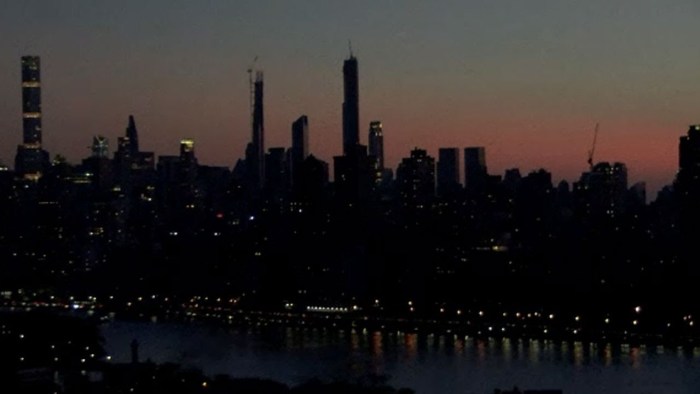
THE 2003 BLACKOUT OF NEW YORK CITY

On August 14, 2003, one of the largest blackouts in New York City history occurred. The blackout originated with a bush fire on a transmission line that caused it to go out of service in Cleveland, Ohio. This was followed by another transmission line that went out of service about an hour later. These two instances caused an overload on transmission lines that began to fail in the eastern part of the United States. Michigan, Ohio, New Jersey, Connecticut, Pennsylvania, Vermont, and parts of Ontario, Canada were affected. Around 4:10 PM, New York City felt the effects as its residents were left powerless, which would continue on for 30 hours. New York State Governor George E. Pataki declared a state of emergency.

Over 400,000 strap-hangers were left stranded in the Metropolitan Transit Authority’s Subway, Metro-North, and Long Island Rail Road, with many of them evacuated and forced to walk home over bridges alongside gridlocked traffic, due to lack of transportation alternatives. New Yorkers also had to be rescued from elevators with the help of first responders. New York Police Department officers and considerate New Yorkers helped to direct traffic as the traffic lights went out of service. Many concerned New Yorkers were in disarray with the September 11, 2001 attacks fresh on their minds. Former Mayor Michael R. Bloomberg spoke to his constituents over several press conferences to assure the loss of power was not the result of “terrorist attacks:”

I can tell you 100 percent sure that there is no evidence at this moment whatsoever that there is any terrorism. But keep in mind, this did start up in Canada. And so we’ll really have to depend on the information that we get from Niagara Mohawk Power or one of our other power companies up there. But in terms of New York City, there is no terrorism whatsoever.

https://www.cnn.com/2003/US/08/14/cnna.bloomberg/index.html

As temperatures were above 90 degrees, Mayor Bloomberg also informed his constituents to open their windows and drink plenty of water. New Yorkers were left at ease with Mayor Bloomberg’s announcement, which then led many to seek out flashlights, batteries, food, and other necessities from nearby convenience and grocery stores. Many stores rushed to give away perishable items to assist those in need. Restaurants and bars saw a surge in business as they served and hosted New Yorkers as many were not able to endure the heat in their homes. New Yorkers had to rely on payphones as telephone and cellular phone service was disrupted. Unfortunately many had to endure the blackout by sleeping in the city’s parks and public buildings, while more fortunate New Yorkers were able to make it home or spend the night at someone else’s home.

Hospitals were forced to work over backup generators to keep operations afloat and support the essential equipment. New York City’s hospitals saw an uptick in admissions to its emergency rooms due to heat and other health problems. Unfortunately 11 New Yorkers died as a result of the blackout.

The MTA saw limited service restored that night around 8:00 PM. Most New York City neighborhoods were with power by the afternoon of Friday, August 15, 2003. Power was not fully restored to the city until around 9:30 PM.

THE “FUN PASS”

MTA kiosk showing unlimited pass options, which includes the fun pass.

In early December 1997, former New York City Governor George E. Pataki introduced a number of unlimited metrocards, which included the “Fun Pass.” The “Fun Pass” was a 1-day unlimited card that let straphangers ride all throughout New York City for one price, 4 dollars. Initially, the Fun Pass was only sold at stations that were tourist destinations, until it was expanded as an option for all New Yorkers. Over the years, the price of the Fun Pass was eventually hiked, until it was discontinued in 2010.  

Former NYS Governor George E. Pataki holding the “gold” Metrocard in 1997

The MTA eliminated the Fun Pass due to New Yorkers that used the card to sell swipes at stations. Swipe sellers bought them in bulk: “they don’t have to re-use any of them more than once every 18 minutes—the time lag the cards are programmed for. Over the course of a day, each one could be used dozens of times, at great profit to the scammer, while the MTA only receives the $8.25 face value of the card.”

Despite the MTA’s claims that the Fun Pass “scams” led to loss in revenue, the Fun Pass was an affordable daily unlimited card that helped many New Yorkers travel at an affordable price. Its removal as an unlimited option was a loss to many working-class New Yorkers.

Although selling swipes are illegal, simply swiping a fellow New Yorker on is not, BUT there is a loophole. You cannot be caught asking for a swipe. NYPD may hit you with fines up to $50 if you are caught asking to swiped onto the MTA. If you see someone that looks like they may need to board, offering to swipe them on is a nice, courteous gesture. 

Since the MTA introduced the Metrocard in 1993, the MTA has collaborated with several artists and brands to create limited edition cards. These cards are usually sold at select stations with limited quantities. In the past few years, MTA has released limited edition cards in collaboration with Supreme, Game of Thrones, Wu Tang Clan, David Bowie, and Paul McCartney. On May 21, 2022, the MTA released a limited edition metrocard to commemorate the 50th birthday of rapper, the Notorious B.I.G. Only 50,000 cards were made and were sold at select stations. Limited edition cards are considered collectables which are resold online from anywhere between $100 to $5,000. Let’s just say it is very profitable.

A WHITE SUPREMACIST BOMBING OF A BLACK ROSEDALE HOME, 1974

In October 1974, a Black couple of Trinidadian immigrants moved to the Rosedale neighborhood in Queens, New York from London, England. Ormistan Spencer, a 34-year old production manager for a photo-engraving firm, and his wife, Glenda Spencer, a 31-year old administrative secretary, brought their three sons along with them. At the time, Rosedale was a majority-white neighborhood while Black families began to settle there from overcrowded areas in New York City. Before the Spencers officially moved into their $40,000 seven-room home at 243-11 136th Avenue, it was fire bombed in July 1974 after the purchase was finalized. The Spencers did not realize what was yet to come as they tried to bring in the new year in their home. 

On December 31, 1974, a fire bomb was placed on the front porch of the home at 4:30 AM, which shattered the front windows. Attached to the fire bomb was a note that read “Nigger, be warned. We have time, we will get you. Your first born first.” The note was signed “Viva Boston KKK.” When the fire bomb blasted, Ormistan and Glenda Spencer were asleep in their bedroom upstairs, while their sons, Irwin, Peter, and Derrick, were in their bedroom downstairs. The boys’ bedroom faced some damage by debris from the blast. Glenda Spencer stated that she “planned to have a party tomorrow to celebrate the fixing up of the house after the July firebombing. Now everyone can come over and see the new damage.” In response to the bombing, the Spencers reported that police guarded the home, with a police officer actually attacked. The Spencers also reported racist slurs hurled at them by cars that passed by the home, but the Spencers maintained that they would not be run out of their home or the neighborhood. Back in London, the Spencers lived in a private home in an area mostly populated with white residents. “In England, you hear about this happening in the South, but you don’t hear about it happening in New York City,” Ormistan Spencer told a reporter. 

By January 6, 1975, two suspects were captured by the New York Police Department after a tip led them to the 113th Precinct to be questioned and later, apprehended. Michael Biggio, a 29-year old accountant for the Board of Education hired 27-year old Arthur Zanoni, a dental technician, to bomb the Spencers’ home for $300. Michael Biggio lived at 224-19 136th Avenue, about a block away from Spencer’s home. Biggio and Zanoni were arraigned separately in Brooklyn Federal Court and was ordered to held on $25,000 bail of possession of an unregistered bomb by US Magistrate Max Schiffman. While in court, Assistant US Attorney Raymond Dearie said Biggio paid Zanoni to “manufacture, detonate, and and set the bomb” at the Spencer’s home on New Year’s Eve. Zanoni and Biggio met a month before the bombing took place in Brooklyn through a mutual friend. Zanoni was traced through the writing of the note that was attached to the bomb. The note was analyzed by the Police Department’s crime lab that connected the writing to the indentation of a notepad that was previously written on. Chemicals were used to bring out a message written on the notepad that read “Hi Nipples, call me as soon as you read this note. Love, Artie.” A number was also uncovered after the message, which was used by detectives to lead to Zanoni’s mother. Zanoni’s mother supplied his name and his Brooklyn address, 239 Nichols Avenue. 

The New York Police Department staked out Zanoni’s home in Brooklyn. Zanoni later contacted the Rochdale police station, the precinct nearest to the bombing, to surrender himself as soon as he contacted his lawyer who was out of town at the time. The agents of the US Treasury Department’s Alcohol, Tobacco and Firearms Bureau arrested Zanoni on January 5, 1975, while he drove near the Aqueduct Racetrack, with Biggio picked up some time later. Zanoni claimed he was on his way to surrender himself to the police when he was picked up by officers. Detectives and federal agents searched Zanoni’s home and found two rifles, electrical tools, and materials that could possibly be used to make a bomb. The agents also found the notepad which the note that was attached to the bomb, a note to his wife, and a third note that contained Biggio’s number and directions to his home. The two suspects brought the bomb to the Spencer home in Biggio’s car and Biggio waited for Zanoni to plant the bomb, and eventualy waited for the bomb to detonate. Zanoni pleaded “not guilty” in court and complained that he was harassed by Black prisoners during his stay at the detention. 

On January 13, 1975, 200 Black people attended the AME Church in Jamaica, Queens to support the Spencers and donate $779 to the family for house repairs. Months later, a devastating acquittal of Arthur Zanoni and Michael Biggio took place at the Brooklyn Federal Court, after 20 hours of deliberation. Despite the notepad evidence and bomb equipment found at Zanoni’s home, Biggio and Zanoni were acquitted of federal gun contral laws. While at the home of the chairman of the group “Restore Our American Rights,” at 242-15 135th Street, Biggio stated “I feel terrific, I knew I would win.” He went on to say “I’m thankful to the people of Rosedale who stuck by me from the beginning when no one else would. The so-called religious, political, and civic leaders of Rosedale turned their backs on me.” 

3 NEW YORK RAP ALBUMS THAT TURN 20

September 11, 2001 was a date that changed the political and social climate of New York City forever. The World Trade Center was attacked, which led to its collapse and the 3,000 lives lost. On the same day, Jay-Z’s “The Blueprint,” heralded as one of his classics dropped, which publicly started the feud between Nas and Mobb Deep. Fabolous’ debut album “Ghetto Fabolous” also dropped on September 11, 2001.  President George W. Bush began his “War On Terror” in October 2001, which led to US troops in Afghanistan. Nas would return the fire to Jay-Z and other Queensbridge peers on his December 2001 release “Stillmatic.” The devastation to New York City and its inhabitants rolled over into the year of 2002. The transition from Mayor Rudy Giuliani to Mayor Michael Bloomberg commenced. 

Tension was high in New York City’s rap climate in 2002, but these albums were able to please our ears.

  1. Cam’Ron – “Come Home With Me
Cam’Ron’s “Come Home With Me” cover

Released on May 14, 2002, Cam’s third studio album, but his Roc-A-Fella debut, is one of the strongest releases from the label to date. Cam’Ron was relatively popular, but this album pushed his fame to newer heights with  “Oh Boy” and “Hey Ma” being two of the biggest rap hits of 2002. The album’s standout tracks “The Roc,” “Welcome To New York City,” and “Come Home With Me,” show Cam’s ability to drive beats and his Harlem sound that no one can replicate. Features from Juelz Santana, Memphis Bleek, Jay-Z, Jim Jones, Daz Dillinger, Beanie Sigel and production from Just Blaze, Rsonist, Kanye West, paired with Cam’s flow, makes for a strong argument of a classic. The album also serves as a strong introduction to Dipset, also known as The Diplomats, the crew that would put New York City in a chokehold.

Jay-Z’s “The Blueprint 2”

Jay-Z – “The Blueprint 2: The Gift & The Curse

Jay-Z’s seventh studio album released on November 12, 2002, was the follow up to his classic “The Blueprint.” With production from The Neptunes, Just Blaze, Kanye West, Timbaland, and No ID, “The Blueprint 2” soared to number 1 on the Billboard charts. The double disc album features 25 songs total. On “Hovi Baby,” Jay-Z gets real arrogant and explains why he’s the top dog. On “03 Bonnie & Clyde,” Jay-Z and Beyonce profess their ride-or-die love for each other, and Jay enamors a woman on “Excuse Me Miss.” The album boasts features from Dr. Dre, Rakim, Scarface, MOP, Faith Evans, Lenny Kravitz and Beanie Sigel.

  1. Nas – “God’s Son”

Nas’ sixth studio album was released on December 13, 2002. It was the follow-up to “Stilmatic,” considered his return to the fight for king of New York. The album was a year fresh off the beef with Jay-Z and the death of his mother, Ann Jones at the beginning of 2002. Nas was inspired, alongside the help of Alchemist, Salaam Remi, and Ron Browz on production, “God’s Son,” is considered a strong release. Nas’ tackles the long origins of the beef with Jay-Z on “Last Real Nigga Alive,” his mother’s passing on “Dance,” religion and societal ills on “Heaven,” and gets braggadocious on “Made You Look.” On “Get Down,” Nas flexes his immaculate storytelling abilities, and he leads the youth on “I Can.” On “God’s Son,” Nas shows his immense technical skill as a lyricist and adds a gem to his discography.

The Stoning Of A Black Couple’s Home

In May 1956, a Black couple faced the harsh reality of Black homeownership in the Bronx.  Percy Hill lived with his wife, Cora Hill at 747 East 183rd Street between Crotona and Prospect Avenues, a predominantly white neighborhood in the East Bronx. Percy, 44 years old, was an elevator operator at the Shelton Hotel. His wife, Cora, 42 years old, was also employed at the Shelton Hotel as a chambermaid. The Hills moved into their $12,450 home on February 27, 1956. The couple’s home had nine rooms and they planned to rent out four of them. The Hills lived there without any racist occurrences until Sunday, May 6, 1956. 

On Sunday, May 6, 1956, a group of white thugs threw stones at the Hills’ home and broke the front porch windows. One of the stones thrown was wrapped in a note filled with racial epithets and a threat of arson to their home if they did not move out of the neighborhood. New York City Mayor Robert F. Wagner Jr declared the incident as an “affront” to the city and ordered Police Commissioner Stephen P. Kennedy to “pursue the matter vigorously as a crime against the city.”About thirty people were questioned, but four whites were arrested in connection to the stoning of the Hills’ home on Thursday, May 10, 1956. The National Association for the Advancement of Colored People and The Hotel Trades Council urged Mayor Wagner to take urgent action in a telegram sent to Police Commissioner Kennedy.

Amongst those arrested were two unnamed 14-year olds that were charged with juvenile delinquency in a children’s court for their appearances on the scene of the stoning. The two were remanded to the Youth House and released on $500 bails. Two others arrested were 25-year old William Pizzolongo of 2309 Crotona Avenue, viewed as the mastermind of the stoning attack; and 16-year-old Richard Ferri, an office clerk of 2426 Crotona Avenue. Pizzolongo and Ferri were charged with malicious mischief, but Ferri was also charged with violation of a penal code as the author behind the threatening letter. Both were charged in Bronx magistrate court, Ferri was released on $1,000 bail, Pizzolongo released on $500 bail. 

William Pizzolongo was eventually convicted later in May 1956 as the mastermind, but later had his sentence suspended in October 1956. “This court will show greater tolerance to the defendant than he showed to the complainant, in hope that there may be some good in the defendant worth saving,” Justice Benjamin Gassman stated as he placed Pizzolongo on probation.

The Great AFRICAN AMERICAN Migration to New York City

Migration map from Pearson Education

As 6 million Southern Black Americans migrated to the Midwest and Northeast to flee economic deprivation, New York City became the home to several Black neighborhoods, such as Harlem and Bedford-Stuyvesant. This mass movement of Black Americans is historically known as “the Great Migration.” Black Americans in Harlem and Bedford Stuyvesant eventually spread throughout the five boroughs for more space. The Great Migration started in the 1910s and lasted for decades until the 1970s. 

Between 1992 to 1995, Gotham Center launched an oral history project that involved various interviews of Southern Black Americans that migrated to New York City titled “African American Migration and Southern Folkways in New York City Oral History Project,” which can be found at the Schomburg Center for Research in Black Culture archives. With stories about their trek to New York City, their work experiences, and even street life, these three narratives offer us just a slight look into the migration up North.

Mary Ruffin

Mary Ruffin was born in Suffolk, Virginia in 1920 to George Ruffin, a landscaper and Grace Ruffin, a housewife. Mary was one of 7 children, 5 daughters, two sons. Mary Ruffin was interviewed by Ray Allen on March 15, 1993. She moved to New York City from Virginia at the age of 20 in the year of 1940. Mary described in detail that she traveled to New York City from Virginia by bus. She stated that the bus stopped at 50th Street and these were her thoughts when she made it to New York City:

“Well, when I looked around — I was kind of a little disappointed — when you get up in these apartments, there’s no front porch. We had been used to going out in the evening and especially in the summertime, you sit on the porch until it’s time to go to bed. There was no front porch, no back door. In a way, you had to get adjusted to it. But once you get adjusted, you make yourself contented… You’ve got to explore it and see the beauty of it. So that’s how you get full pleasure from the City.”

Mary Ruffin, African American Migration and Southern Folkways in New York City Oral History Project, Gotham Center

When Mary arrived in New York City, she moved to Harlem, specifically West 134th Street and 8th Avenue. She explained that the neighborhood was mostly populated with Southern Black Americans and there wasn’t much diversity until heavy immigration began. Interviewer Ray Allen inquired about Mary’s work experience and the opportunities she received upon her move up North. Mary started out with factory work: “Some of them were like piece work; bead factory I worked too; and I worked at a soap factory. I worked at quite a few factories before I got to nursing.” 

Mary goes on to share what made her get into the nursing trade:

Well, I thought it was a better opportunity. There were more benefits there. Working at the factory you didn’t get very many benefits. So, I worked with the city. My teacher taught me to work with the city when I finished. She said you get more experience by being a practical nurse because in some of the private hospitals they don’t let the practical nurse do everything. You can only do certain things, but in a city hospital, they let you do everything because there’s always a shortage and there’s no one else there to do it. So you have to do it so you get more experience that way.

Mary Ruffin, African American Migration and Southern Folkways in New York City Oral History Project, Gotham Center

Her practical nursing program was offered at the YWCA, was a year long, and led her to work as a practical nurse for New York City for 27 years.

We went to class for three months during the day and then after the three months we started affiliating at the hospital, working at the hospital. It was getting your training, then at the hospital. So you had another nine months to get your training at the hospital, but you still went to class. You had to go to class twice a week while you were working in the hospital. So, when I finished I put in 5 or 6 applications and I got an answer from all of them to come in to work. Except the one that hired me. The supervisor told me to come back November the 16th, so I took her work and I went back November the 16th and they hired me. That was at James Hospital for Cancer Research…. I was there for 13 years and then they replaced us somewhere else when they closed it down and I went to Metropolitan because it’s here by me and I could walk there. You had three choices and they tried to give you your first preference. So I went to one beer by me and I was there for 14 years. That’s a general hospital.

Mary Ruffin, African American Migration and Southern Folkways in New York City Oral History Project, Gotham Center

Gertrude Dobson Stallings Rose

Gertrude Dobson Stallings Rose,interviewed by Ray Allen, was born in Keenensville, North Carolina on April 6, 1915 to Tommy Dobson and Needham Dobson, a farming family. She was one out of 13 children, fourth born. Gertrude’s family farmed corn, peanuts, tobacco, and sweet potatoes. The land her family cultivated crops on were owned by them, which meant they were not sharecroppers. In her interview with Ray Allen, Gertrude recalled her 5-mile walks to school, which eventually led to her paternal uncle building a school for the children to cut out the long daily commute. The school was first named “Stockinghead,” then later became “Dobson Community Center.” 

Gertrude moved to New York City with her husband and six kids in 1955 by car. Her husband William Henry Stallings was a farmer. She stated the reason that she moved to New York City was because her sister insisted and already lived there. Gertrude explained that leaving the farm to work in a big city was scary: “It was, it was difficult, but it was a thing that we had to do, we had to just go.” When she arrived in New York City, all she cared about was work to provide for her family. Gertrude and her family moved to Kingston Avenue in Bedford-Stuyvesant, but eventually moved to 179 Stuyvesant Avenue. William worked in construction and Gertrude worked in a baseball cap factory. Gertrude stated that Bed-Stuy was a Black and Puerto Rican neighborhood riddled with crime that made her feel unsafe. 

James Sanders
James Sanders, interviewed by Ray Allen, was born in Bennettsville, South Carolina on January 11, 1941 to Mutt Graves and Rebecca Sanders, sharecroppers: “My parents? My parents, they were farmers and they did sharecrop, you know what sharecrop means? Sharecrop that means to farm.” James stated that his aunt was already in New York City and called to have him sent up when he was 11 years old:
“ Yeah, cause my aunt called up and let her know that they wasn’t treatment me right down there, you know cause then I was living with my aunt, then after I left my aunt I started living with my uncle, so my uncle’s wife used to mistreat us – me and my sister – and so my mother found out about it, so she came down. My aunt sent me – my mom came down to get my sister – then my aunt sent me.”


James went into detail into how he actually made it to New York City: “No, no. It was an old man they called “Willy Frazier,” he was like a cab driver, he brings everybody to New York and then he take you back. And he’s still doing it, he’ll bring you to New York.” James stated that Willy Frazier brought millions of people to New York in a station wagon.
James also spoke in detail about gangs in Bed-Stuy:

I would stay clear if that. When you come up from the South, you were taught New York is bad, that’s number one – New York is bad, you keep your distance, although they were trying to make me get into a gang, I used to fight to protect myself and to protect my family, you know because back in them days, if you didn’t join the gang, then they would you know do something with your parents, so I didn’t like that. But they tried hard, and I paid my dues in Brooklyn. I paid mine.

James Sanders, African American Migration and Southern Folkways in New York City Oral History Project, Gotham Center


He stated that the neighborhood was mixed in 1952 when he arrived. James lived on Gates and Tompkins Avenue in Bed-Stuy. James named some of the gangs in Bed-Stuy during the time by name: “The Choppers, the Bitches, the El Puentos, the Stompers.”
At the time of the interview, James owned a bakery, but he did speak in detail about work experience:

I used to work in a little fish and chips, a little, small place, it wasn’t bigger than this office, and you know down in the basement I’m cleaning the fish and I’m thinking in my mind, I said, ‘one day I will have something bigger than this here.’ And that’s how it started from, because the guy he didn’t never want to learn me but his wife learned me how to you know working to cook and clean the fish and stuff, because he got sick.”

James Sanders, African American Migration and Southern Folkways in New York City Oral History Project, Gotham Center

James described the “soul food” he learned to cook for a mostly Black clientele:”Collard greens, peas and rice, fish, chicken, a little of everything, a little of everything.”

The Great Migration to New York City helped create Black neighborhoods that became meccas. The narratives of these migrants help give us in-depth looks into those who bravely fled the South in search of opportunity and freedom from Jim Crow.

Harlem’s Queen Of Numbers

Stephanie St. Clair, also known as Queenie

In the era of Prohibition, a street-savvy Black woman reigned supreme as she created Harlem’s first female-owned policy rackets bank, and amassed wealth through illicit activity that was dominated by men. Known by several aliases such as “Queenie,” “Madam St. Clair,” the “Queen Of Policy Rackets,” and “Madam Queen,” she was born Stephanie St. Clair on December 24, 1897. Stephanie St Clair was of a French-Caribbean background, born in the island of Guadeloupe. In 1911, a 13-year old Stephanie set out to Canada and subsequently made her way to New York City the following year. According to historian Shirley Stewart, St. Clair may have been employed in domestic work, but those gigs were not enough to fund her numbers bank.

Madam St. Clair dated a few men that helped her get her feet wet in Harlem’s street life.  She was attacked by a gangster she dated, stabbed him in the eye in defense, and fled Harlem to avoid retaliation. Upon her return to Harlem, she was greeted with news of his death. St. Clair then dated another man and engaged in his business of dealing illicit substances. The revenue from this business was used as an investment for her numbers bank. St. Clair parted ways with her boyfriend and attempted to seize the entire business from him. The boyfriend did not take kindly to St. Clair’s attempt to strong-arm him. The break up led to a physical struggle, which ended up in the boyfriend’s death, from a fatal blow to his head on a table edge after Stephanie pushed him. Stephanie eventually took over the business completely and subsequently joined the street gang, “40 Thieves,” as a rank-and-file member. 40 Thieves is New York City’s oldest known street gang, whose members were primarily Irish-Americans and immigrants. Stephanie’s membership developed into her leadership over the gang. 

St. Clair’s street endeavors led her to invest $10,000 in the establishment of her numbers bank in 1923. Numbers is also known as policy racket, but what exactly is it?

One of the biggest money making operations regarding illegal lotteries was the policy racket. It was also called the numbers racket, the numbers game, or simply ‘playing the numbers’. This poor man’s lottery operated primarily in poor Black, Latino, and Italian neighborhoods from the late 1890’s well into the 1960s. Some cities that were major cogs in the policy racket were New York, Chicago, Cleveland, Pittsburgh, and Atlanta just to name a few. The game itself consisted of a player picking any three digit number from 0 to 999. The odds were about a 1000 to 1 against winning while the pay off might be anywhere from 600 and 800 to 1 for a winner. Bets were generally a nickel or a dime, but any amount was acceptable even that as small as a single cent.

https://discover.hubpages.com/education/History-of-the-Policy-Racket-in-Black-America

St. Clair was protected by many men, but her strongest ally was Ellsworth “Bumpy” Johnson. Bumpy Johnson acted as her enforcer. With the protection of men, her fierce attitude and street smarts, St. Clair was able to make $250,000 a year with the numbers bank, making up to $7,000 a day according to her.

Known for her extravagant looks and lifestyle, St. Clair resided in a townhouse in the Sugarhill section of Harlem, 409 Edgecombe Avenue. 409 Edgecombe Avenue is a historic address that has been home to W.E.B Dubois, Aaron Douglas, Thurgood Marshall, and Roy Wilkins. During this time, Stephanie wrote columns for a local newspaper on topics, such as police brutality against civilians and prisoners. Her 409 Edgecombe home was raided by police suspicious of her engagement in the policy rackets in 1928. This incident led to her writing more columns against police abuse and letters to city officials that detailed their excessive force.

On the morning of Monday, December 30, 1929, St. Clair was arrested for possession of policy slips in the hallway of 117 West 141 Street by Detective Roberts, taken to the West 135th Street police station, and held on $2,500 bail at the Washington Heights court. Detective Roberts claimed St. Clair was found with six envelopes filled with policy slips. Due to hospitalization to treat an illness, St. Clair missed her January 8, 1930 court appearance. Her attorney Frank Stanton was able to prove her hospitalization with a doctor’s certificate. She was arrested after release from the hospital, then released on bail in anticipation for the January 20 appearance.

On March 14, 1930, she was sentenced to an indefinite period, but served eight months, but she did not go down without a fight. As she fought for an acquittal, St. Clair claimed that she did not publish letters in a local newspaper that disparaged the police in Harlem. Her defense was that she was from Montserrat and unable to write in English. St. Clair was ordered to write a few words for the court to compare her handwriting to the letters sent to the local newspaper. Similarities between the handwritings led the court to find her guilty, but she continued to fight. Although she admitted her involvement in the numbers business for a short period of time, she quit in 1928 due to extortion by police officers. She claimed on the day she was arrested on West 141 Street, she was only visiting her friend Mrs. Murray, to sign incorporation papers for a new company she formed. The letters were produced as evidence to the court, but Mrs. Murray’s name was not included as an incorporator. St. Clair’s defense was weakened when the handwriting on the policy slips were also compared to the letters. Lastly, Officers Hunter, Robert, and Carter arrested several “numbers collectors” at 580 St. Nicholas Avenue. Several of them claimed to work for St. Clair. After her sentence was given, she vowed to testify in the Seabury Investigation upon her release. St. Clair served her eight months at the workhouse on Welfare Island, now known as Roosevelt Island.

On December 8, 1930, Stephanie St. Clair exposed her regular payments to police officers in exchange for protection of her policy games, while on the stand. St. Clair admitted to a time she paid a fee of $1,100 to Lieutenant Peter J. Pfeiffer. Her payment to Pfeiffer was done through “Mustache” Jones, a well-known Harlem gangster. She testified that while running her numbers bank from 1923 to 1928, she paid $6,000 to several officers. St. Clair even testified that she witnessed officers with Chile Mapocha Acuna. Acuna worked with over thirty police officers as their informer and helped to frame innocent women unless they were able to pay the officers off. Acuna testified this in court a week prior to St. Clair’s appearance. St. Clair implicated about four other officers, including one she alleged stole $400 from her.

By the 1930s, Italian mobsters started to move into the rackets in Harlem as their money sources dried up due to the Great Depression. A prominent Bronx mobster, Arthur “Dutch” Schultz, set out to strong-arm the Black policy bankers in Harlem, and became St. Clair’s biggest rival. Schultz either forcefully snatched their businesses or forced the bankers to pay him a percentage of their daily earnings. St. Clair quickly organized Black policy bankers against Schultz:

St. Clair moved swiftly against Schultz, organizing the remaining small Black policy owners in her fight against “the Dutchman.” She and her allies violently confronted white storeowners who were collecting bets on Schultz’s behalf, smashing cases, destroying policy bets and ordering their adversaries out of Harlem. St. Clair also took out ads encouraging Harlemites to “play black” and only place numbers bets with Black organizers.

https://www.smithsonianmag.com/history/meet-stephanie-st-clair-immigrant-turned-millionaire-who-dominated-harlems-gambling-underground-180977759/

St. Clair stated “It’s Dutch’s life or mine. Dutch’s men know that I am the only one that can take back the racket he stole from my colored friends.” Schultz would retaliate against St. Clair as he sent various threats to her home, murdered her soldiers, and even placed a hit on her life. By this time, St. Clair was no longer protected by Bumpy Johnson. Schultz even sent a man to her home to intimidate her, but her body guards locked him in a closet and possibly murdered him. St. Clair called on help from Mayor McKee as she feared Schultz would put her on the spot, as well as continue to terrorize the Black policy racket owners.

Schultz and St. Clair’s feud would come to an end on October 25, 1935. Schultz was murdered in Newark, New Jersey. Charles “Lucky” Luciano, head of The Commission, ordered Schultz’ hit. St. Clair sent a telegram that day, which was reportedly the last thing Schultz read as he died. The telegram read: AS YE SOW, AS YE SHALL REAP.”

After Schultz’s death, St. Clair went on to marry Sufi Abdul-Hamid, notoriously known as “Black Hitler” in August 1936. Abdul-Hamid advocated for the destruction of Jewish businesses as he advocated for more Black businesses. Sufi Abdul-Hamid was a very controversial figure and their marriage did not last long. St. Clair caught wind of Abdul-Hamid’s affair with a woman, Madam Futtam. St. Clair was arrested for Abdul-Hamid’s attempted murder on January 18, 1938. Abdul-Hamid was hit on above his mustache and he was able to disarm St. Clair, then hold her for the arrest. For the shooting, St. Clair was sentenced two to ten years. In court, she thanked the judge and was carried away to serve the sentence.

Upon release, St. Clair steered clear from illicit activity, but still lived off the wealth she made as a policy banker. She continued to advocate for the civil rights and economic progress of Black people. She remained mostly secluded and out of the spotlight. St. Clair passed away quietly in Harlem in December 1969.